 ॐ त्र्यायुषं जमदग्नेः कश्यपस्य त्र्यायुषम् ।
यद्देवेषु त्र्यायुषं तन्मे अस्तु त्र्यायुषम् ॥
oṃ tryāyuṣam jamadagñeḥ kaśyapasya tryāyuṣam |
yat deveṣu tryāyuṣam tat me astu tryāyuṣam ||
-
- oṃ — sacred syllable
- tryāyuṣam — the Tryāyuṣa (that which grants threefold longevity)
- jamadagñeḥ — of Jamadagni
- kaśyapasya — of Kaśyapa
- tryāyuṣam — the threefold‑longevity power
- yat — which
- deveṣu — among the gods
- tryāyuṣam — the threefold‑longevity essence
- tat — that
- me — to me
- astu — let it be
- tryāyuṣam — the threefold‑longevity (blessing)
In Atharva‑vedic literature, tryāyuṣa / tryāyuṣam denotes:
that which grants, protects, or embodies threefold longevity.
The term is not merely “long life” but a technical Atharvanic category of life‑force, connected with:
- āyuḥ (vital duration)
- prāṇa (life‑breath)
- ojas (vital strength)
Thus tryāyuṣa is a compound of ritual potency, not a simple adjective. These three are the tryāyuṣam as well.
Three in Tryāyuṣa
Atharva‑vedic commentators and later śrauta‑traditions interpret the “three” in three principal ways:
(a) Three life‑stages. Tryāyuṣa is that which protects life through all three stages.
- bālya/yauvana — youth: Lagna🐏0-24
- Prauḍha (प्रौढ mature)— adult: 5H🦁24-60
- vṛddha — old age: 9H🏹60-108
(b) Three vital supports – tryāyuṣa is the integrated vitality of the three chief breaths.
- prāṇa
- apāna
- vyāna
(c) Three cosmic spheres -tryāyuṣa is the cosmic life‑principle that pervades all three realms.
- pṛthivī (earth) भू
- antarikṣa (mid‑space) भुव
- dyu (heaven) स्वः
All three interpretations coexist in Atharvanic exegesis. Tryāyuṣa appears in healing, longevity, and protection hymns, especially in: AV 2.30, AV 6.102; AV 19.26–27 (the Tryāyuṣa hymns proper). Its function is to restore lost vitality, to extend lifespan, to protect from premature death (apamṛtyu), to re‑establish the balance of prāṇa‑ojas‑tejas. Thus it is a therapeutic mantra‑power, not merely a blessing.
Jamadagni and Kaśyapa
In Atharvanic tradition, certain sages are custodians of specific life‑powers.
- Jamadagni is linked with fiery tapas and vital heat (tejas).
- Kaśyapa is linked with stability, progeny, and longevity.
Thus “Jamadagñeḥ Kaśyapasya tryāyuṣam” means: the specific life‑potency that these ṛṣis possessed and transmitted. This is why the mantra invokes their names as sources of the life‑essence.
Tryāyuṣa as a “transferable” life‑force
A distinctive Atharvanic idea is that āyuḥ can be invoked, transferred, and installed through mantra. Tryāyuṣa is therefore:
- a quantifiable life‑substance
- a ritual potency that can be invoked from gods, sages, or cosmic realms
- a protective sheath (āyuḥ‑kośa) around the supplicant
Hence the desire: yat deveṣu tryāyuṣam tat me astu tryāyuṣam meaning May the divine life‑essence become mine. This is a direct request for the transference of vitality. In later literature tryāyuṣa becomes associated with rasāyana (rejuvenation therapy), tantric manuals treat it as a mantric ojas‑enhancer and some nighaṇṭu list it as a category of life‑prolonging mantra‑dravyas. Thus the Atharvanic meaning persists as a technical term for life‑extension.
Jamadagni
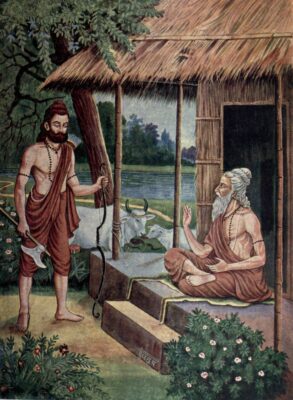
Jamadagni is a prominent sage of the Bhṛgu lineage, known in Vedic literature as a figure of intense tapas and fiery spiritual radiance. His name itself—derived from jama (heat) and agni (fire)—encapsulates his identity as one who embodies or restrains sacred fire. In the Ṛgveda he appears as a seer of hymns and as a custodian of brahmatejas, the inner luminosity that empowers mantra and austerity. His Vedic persona is austere, fiery, and contemplative, rather than narrative or mythic.
In the Atharva Veda, Jamadagni acquires a special significance as a source of āyuḥ‑śakti, the life‑force invoked in healing and longevity rites. Atharvanic tradition treats certain sages as reservoirs of specific vital potencies, and Jamadagni is invoked particularly for his tapas‑generated vitality, which strengthens prāṇa, ojas, and tejas. This is why mantras such as the Tryāyuṣa explicitly call upon “Jamadagni’s Tryāyuṣa,” seeking to draw upon the life‑essence he accumulated through ascetic heat. His association with longevity, protection from premature death, and restoration of vitality is therefore doctrinally precise, not symbolic.
Purāṇic literature expands his figure into a householding sage, husband of Reṇukā and father of Paraśurāma. Here he is portrayed as a master of austerity whose fiery temperament and spiritual power are central to the narratives surrounding him, including the famous conflict with Kārtavīrya Arjuna. Despite the mythic elaboration, the underlying theme remains consistent: Jamadagni represents tapas, tejas, and the potency of disciplined spiritual heat.
Across Vedic, Atharvanic, and Purāṇic layers, Jamadagni stands as a symbol of ascetic power, vital radiance, and life‑sustaining energy. His name in āyuṣya‑mantras is not ornamental but functional, invoked to channel the specific life‑force he is believed to have mastered and transmitted.
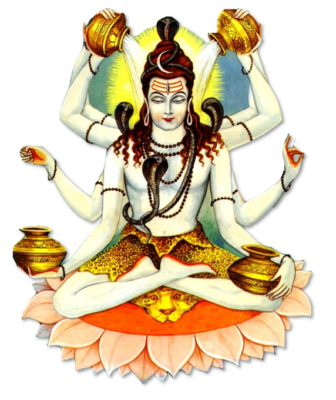
Learn how to apply Bhasma. Get bhasma from a jyotirlinga or any other sacred space of Lord Shiva