Brāhma‑Māna: The Cosmological Measure of Time in Hindu Thought
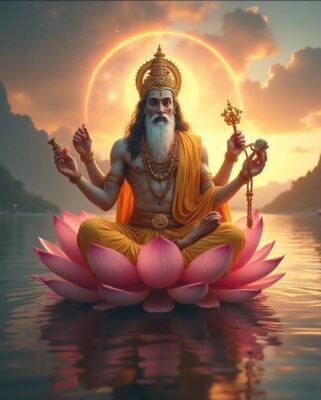 Brāhma‑māna (ब्राह्म‑मान) refers to the cosmic scale of time measurement grounded in the lifespan of Brahmā, the creator deity in Purāṇic cosmology. This system represents the largest temporal framework in Hindu thought, extending from the cycles of yugas to the vast expanse of Brahmā’s hundred-year lifespan. This article examines the concept of Brāhma‑māna through Purāṇic sources, its mathematical structure, philosophical implications, and its role in the Hindu understanding of cyclical creation.
Introduction
Time in Hindu cosmology is not linear but cyclical, unfolding through repeating patterns of creation, preservation, and dissolution. Among the various temporal scales described in the Purāṇas, the most expansive is the Brāhma‑māna, the “measure of Brahmā.” This system situates human history within a cosmic chronology that spans trillions of years, thereby emphasizing the vastness of the universe and the insignificance of individual epochs when viewed from a divine perspective.
Etymology
The term Brāhma‑māna is a compound:
- Brahmā — the cosmic creator, presiding over the unfolding of the universe
- Māna — measure, scale, or unit of quantification
Thus, Brāhma‑māna literally means “the measure of Brahmā,” referring to the temporal units defined by Brahmā’s day, night, year, and lifespan. This system is elaborated in texts such as the Viṣṇu Purāṇa, Bhāgavata Purāṇa, Matsya Purāṇa, and Manusmṛti, which provide concordant numerical values for the major cycles.
Structure of Brāhma‑Māna
1 The Yuga System
The smallest unit in the Brāhma‑māna framework is the Mahā‑yuga, consisting of four yugas:
- Satya Yuga — 1,728,000 years
- Tretā Yuga — 1,296,000 years
- Dvāpara Yuga — 864,000 years
- Kali Yuga — 432,000 years
Total: 4.32 million years
This cycle repeats endlessly.
2 Kalpa: The Day of Brahmā: A Kalpa is defined as 1000 Mahā‑yugas, equaling: 4.32 billion years. This is Brahmā’s daytime, during which creation (sṛṣṭi) is active.
3 Rātri: The Night of Brahmā: Brahmā’s night is of equal duration: 4.32 billion years. During this period, the universe undergoes pralaya, a dissolution into subtle potentiality.
4 Ahorātra: One Full Day of Brahmā: Combining day and night: 8.64 billion years. This is one complete cycle of creation and dissolution.
5 Varṣa: One Year of Brahmā: A year of Brahmā consists of 360 such days: 3.1104 trillion years
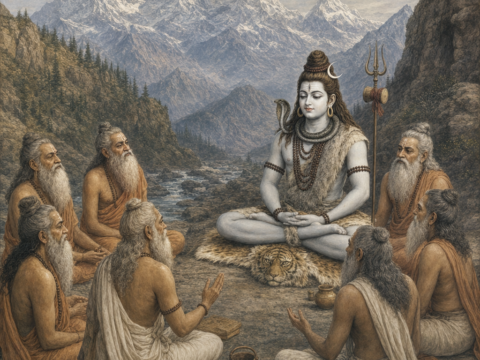
6 The Lifespan of Brahmā: Brahmā lives for 100 such years, known as a Mahā‑kalpa or Para: 311.04 trillion years. At the end of this lifespan, a Mahā‑pralaya occurs, dissolving even the higher cosmic realms i.e. maahr, janar etc. are all dissolved. What survives? What is this form of Rudra?
Our Position in the Current Brāhma‑Māna Cycle
According to the Purāṇic chronology:
- 50 years of Brahmā have already passed
- We are in the first day of the 51st year
- This day is the Śveta‑Varāha Kalpa
- Within it, we are in the 7th Manvantara (Vaivasvata)
- Within this Manvantara, the 28th Mahā‑yuga
- And specifically in the Kali Yuga, which began in 3102 BCE
This placement situates human civilization within a vast cosmological continuum.
Philosophical Significance
The Brāhma‑māna system is not merely numerical; it conveys profound metaphysical insights:
1 Relativity of Time
Time is experienced differently by different beings. What is a day for Brahmā is billions of years for humans. This anticipates the idea of relative time, later echoed in modern physics.
2 Impermanence of Creation
Even Brahmā, the creator, is not eternal. His lifespan, though immense, is finite. This reinforces the Hindu doctrine that only Brahman (the Absolute) is eternal, while all manifested worlds are transient.
3 Cyclicality and Recurrence
Creation is not a singular event but a recurring cycle. The universe undergoes repeated expansions and contractions, mirroring natural rhythms observed in seasons, biological life, and cosmic processes.
6. Scriptural References
A representative Purāṇic verse (paraphrased for copyright compliance) states: A thousand cycles of the four yugas make a day of Brahmā, and a thousand such cycles form his night. This formulation appears in the Bhagavad Gītā 8.17, Viṣṇu Purāṇa 1.3, and Bhāgavata Purāṇa 3.11.
7. Conclusion
Brāhma‑māna offers one of the most sophisticated and expansive temporal frameworks in world cosmology. By situating human existence within a timeline spanning trillions of years, it invites a contemplative understanding of reality—one that emphasizes humility, cosmic order, and the cyclical nature of creation. Far from being a mythic exaggeration, the Brāhma‑māna system reflects a profound attempt to articulate the rhythms of the universe in metaphysical and mathematical terms.