
सप्तकस्य संख्यातत्त्वम्
 The Vedic vision of the universe begins with nāda, the primordial vibration. “nādo hi brahma,” declare the sages—sound itself is Brahman. In this worldview, music is not entertainment but cosmic mathematics, a bridge between the audible and the eternal. Among its most profound structures is the saptaka, the octave, whose numerical logic mirrors the architecture of creation.
- Sapta: The Sacred Numerical Spine of the Vedas
सप्तसंख्या विश्वरचनायाः मेरुदण्डः
The octave is called saptaka because it contains seven distinct notes—Sa, Re, Ga, Ma, Pa, Dha, Ni. The number seven (sapta) is foundational in Vedic cosmology:
- सप्त ऋषयः — Seven sages
- सप्त सिन्धवः — Seven rivers
- सप्त लोकाः — Seven worlds
- सप्त अश्वाः — Seven horses of the Sun
- सप्त चक्राणि — Seven chakras
This recurrence is not coincidence but design. The Vedic mind saw seven as the number through which creation unfolds. Thus:
“यथा ब्रह्माण्डे तथा पिण्डे” As in the cosmos, so in the body.
The seven notes of the octave reflect the seven layers of existence.
- The Octave as a Mathematical Cycle
द्विगुणनं सप्तकस्य मूलम्
Though seven notes are named, the octave is an eight-step cycle, because the eighth is the return of the first at double frequency:
This 2:1 ratio is the heartbeat of the octave. The Vedic seers expressed this principle poetically:
“अधस्तात् षड्जः, उपरि षड्ज एव” The lower Sa and the upper Sa are one, yet two.
This doubling symbolizes punarāvṛtti—renewal, cyclic time, the eternal return (kāla‑cakra).
- The Three Saptakas and Human Physiology
 मन्द्र–मध्य–तार सप्तकाः
Indian music divides the octave into three registers:
- मन्द्र सप्तकः — the lower octave
- मध्य सप्तकः — the middle octave
- तार सप्तकः — the upper octave
These correspond to vibrational zones of the human body:
- Mandra resonates in the chest
- Madhya resonates in the throat
- Tāra resonates in the head
Thus the octave becomes a psycho‑physiological map, aligning with the chakra system:
- सा Sa → Mūlādhāra
- री Re → Svādhiṣṭhāna
- गा Ga → Maṇipūra
- मा Ma → Anāhata
- पा Pa → Viśuddha
- धा Dha → Ājñā
- नी Ni → Sahasrāra
The ascent through the octave mirrors the ascent of consciousness.
- Vedic Numerology and Musical Vibration
संख्याशास्त्रं च नादशास्त्रं
Vedic numerology (saṅkhyā‑śāstra) assigns vibrational qualities to numbers 1–9, each governed by a planet (graha). This parallels the vibrational nature of musical notes:
| Note | Sanskrit Name | Vedic Number | लोक | Energy |
| Sa | षड्जः | 1 | कुज | Origin, stability |
| Re | ऋषभः | 2 | सूर्य | Fluidity |
| Ga | गान्धारः | 3 | शुक्र | Expansion |
| Ma | मध्यमः | 4 | बुध | Transition |
| Pa | पञ्चमः | 5 | चंद्र | Harmony |
| Dha | धैवतः | 6 | शनि | Beauty |
| Ni | निषादः | 7 | गुरू | Ascent |
This mapping is interpretive, yet it reflects the Vedic belief that sound and number share one grammar.
- The 22 Śrutis: Vedic Micro‑Mathematics
 बाविंशतिः श्रुतयः—सूक्ष्मगणितम्
The Vedic musical system divides the octave into 22 śrutis (microtones). This is far more refined than the Western 12 semitones.
Śruti distribution: Sa: 4, Re: 3, Ga: 2, Ma: 4, Pa: 4, Dha: 3, Ni: 2
This asymmetry shows that Vedic music was based on natural harmonic ratios, not equal temperament. The sages tuned instruments like the vīṇā using precise mathematical listening:
“श्रुतिर् मातृका, स्वरः पुत्रः” Śruti is the mother; the note is her child.
- The Octave as a Spiritual Metaphor
सप्तकस्य आध्यात्मिकं रूपम्
Ascending the octave is symbolic of spiritual ascent:
- From gross to subtle
- From body to mind
- From mind to soul
- From nāda to nāda‑brahman
The upper Sa represents merging back into origin, just as the soul returns to Brahman.
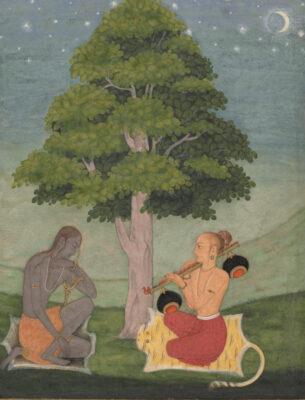 “नादोऽन्ते ब्रह्म प्राप्यते” In the end of sound, Brahman is attained.
- Conclusion
उपसंहारः
The Vedic octave is not merely a musical interval. It is a numerical, cosmological, and spiritual principle. It unites:
- गणित (mathematics)
- नाद (vibration)
- योग (inner ascent)
- ब्रह्माण्ड (cosmos)
In the Vedic imagination, to ascend an octave is to ascend the universe itself.
“सप्तकं ब्रह्माण्डस्य प्रतिरूपम्” The octave is the reflection of the cosmos.