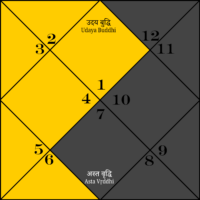
 The binary system is a simple continuous day-night experience in earth. The complete day of 24 hours is a zero “0” because every sunrise is like a reset. The daytime is numerical “1” and relates to the Sun who creates the day by appearing in the eastern horizon. The nighttime is numerical “2” and relates to the Moon who is seen after the Sun sets in the western horizon.
1 The power and authority of the Sun is seen from sunrise [East] as all the stars of the sky rush to hide. He claims the suzerainty of this solar system, and none can dislodge him. He is the greatest tapasvī (तपस्वी) of all time and continues to burn with pure spiritual energy.
2 Moon gets empowered by the authority of the Sun. it does not have its own light and only throws its weight based on the reflected light from the Sun. And she takes control of the night domain when the Sun sleeps.
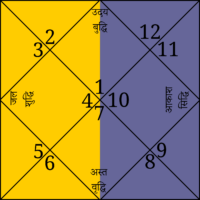 In the binary system used by chips and computers we see that since the lagna with śunya weight (zero) cannot handle anything, the Moon takes over the lagna and continues to feed it and keep it alive. Since the Moon → Lagna, we say 2 → 0, and the binary system becomes 0-1 or a two number system.
Two places follow the binary system – the sunrise and sunset signs as they hold both the day and night energy. Interesting to know that when we split these two sunrise-east and sunset-west, into two parts, we have a zodiac with 14 signs and these symbolise the 14 realms of Brahmā, the Creator.
List of the numbers and the graha ruling the numbers –
Table: Vedic Numerology
| № | 0 | 1 | 2 | 3 | 4 | 5 | 6 | 7 | 8 | 9 |
| Gr→ | Lg | Su | Mo | Ju | Ra | Me | Ve | Ke | Sa | Ma |
The decimal system is one of the oldest numerical systems developed by India along with the dozen (12) for the 12 vedic signs.
📜Āryabhaṭīya
 स्थानं स्थानं दशगुणं
sthānaṁ sthānaṁ daśaguṇaṁ
Meaning: From one place to the next, the value increases tenfold.
This is the clearest early Sanskrit statement of the base‑10 positional system: each digit’s value depends on its position, increasing by powers of ten.
In Jyotiṣa, the decimal system is not just a counting method—it is the mathematical backbone that makes astronomical calculation possible. Every core operation in Siddhānta astronomy depends on place‑value, powers of ten, and decimal fractions.
📜Mean motions (madhyama-gati): Planetary mean motions are expressed in degrees–minutes–seconds, a pure decimal structure (each place is ×60, but the number itself is decimal).
Śloka (Āryabhaṭīya, Golapāda)
bhānor ahorātra-gatiḥ ṣaṣṭy-aṁśaiḥ parimīyate
Translation: The Sun’s daily motion [ahorātra ~ horā] is measured in sixty parts (minutes). Aho (daytime) is 30 min and rātra (nighttime) is another 30 min bringing the daily (ahorātra) total to 60 min or 1°
Even though the subdivision is sexagesimal, the numerical representation is decimal, enabling precise tabulation.
📜Epicyclic corrections (manda & śīghra): All siddhānta compute both (a) manda-phala (slow anomaly which is like śani ~ the slow moving Saturn) and (b) śīghra-phala (fast anomaly which is like chandra ~ the rushing Moon). These require multiplication, division, addition/subtraction and interpolation which is done in decimal positional notation.
Śloka (Sūrya Siddhānta 2.9)
daśaguṇaṁ sthāna-sthānaṁ
Translation: Each place is ten times the next.
This is the explicit rule of decimal place‑value, applied directly in astronomical tables.
 📜Trigonometric tables (jya, koti-jya): Indian sine tables (jya) are given in decimal numbers, often up to 3–4 digits.
Śloka (Āryabhaṭīya, Tri-koṇa-pāda)
ardha-jyā viṣkambhārdhe
Aryabhata’s sine table is entirely decimal, allowing interpolation, correction, iterative refinement. Decimal fractions make the table usable for precise planetary longitude.
📜Time calculations (kāla-vibhāga): Jyotiṣa divides time into five tattva-body parts called pañcāṅga.
वार vāra is solar day
तिथि tithi is a soli-lunar day
करण karaṇa ½ tithi
नक्षत्र nakṣatra is lunar day
योग yoga is another soli-lunar day
In addition there is the muhūrta, the 1/30th part of day, which is like a tithi within the day. And there is ghāṭikā which is ½ muhūrta just like karaṇa which is ½ tithi. Even nāḍī calculations are all expressed in decimal numerals in siddhāntic texts.
Śloka (Sūrya Siddhānta 1.12)
triṁśad ahorātra-muhūrtāḥ
Translation: A day consists of thirty muhūrta.
The number 30 is a decimal integer; all subdivisions are computed using decimal arithmetic.
📜Planetary tables (gaṇita-pañcāṅga): Every pañcāṅga uses decimal tabulation for decimal longitudes, decimal velocities, decimal corrections, decimal time units. Without decimal place‑value, pañcāṅga computation is impossible.
Interpolation (antara-gaṇita) uses decimal fractions to compute sunrise, moonrise, ascendant (lagna), transit times. Jyotiṣa uses linear interpolation, which requires decimal fractions.
Śloka (Sūrya Siddhānta 3.21)
antaraṁ laghu yojyam
Translation: The small difference (antara) is to be applied.
Decimal arithmetic is essential here.
📜Zero (śūnya) enables modern Jyotiṣa calculations. Most modern historians who only believe in written texts and books say that Brahmagupta (628 CE) formalized zero, enabling multi‑digit longitudes. However, many centuries before that the ṛṣi used śunya and decimal system. These pañcāṅga have ephemeris tables and iterative corrections.
Śloka (Brahmasphuṭasiddhānta 18.30)
śūnyaṁ sthānaṁ
Translation: Zero is a place (holder).
This is the foundation of positional decimal astronomy.